
Solar Case Study
Ted & Megan
Ted & Megan
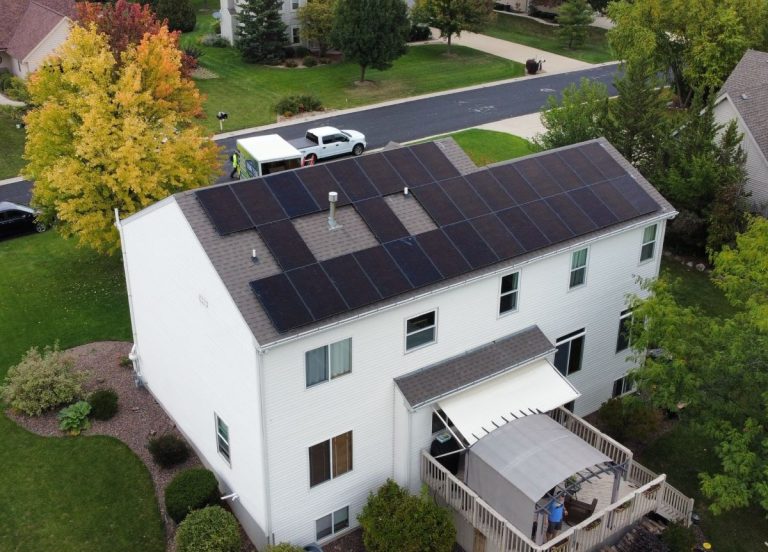
System Size = 11.68 kW-dc
Solar Panels = 32 x Qcell 365W
Inverters = Enphase Microinverters
Racking = IronRidge
Location: Menomonee Falls, WI
Estimated Annual Production = 15,200 kWh
2024 Actual Production = 16,000 kWh
2025 Actual Production = 15,800 kWh
4% Over Production!
Installation Price = $31,900
Federal Tax Credit = -$9,570
Focus on Energy Rebate = -$500
Net Investment = $21,830
.
2024 Production Value
16,000 kWh x $0.17/kWh = $2,720
2025 Production Value
15,800 kWh x $0.18/kWh = $2,844
25 Year Savings Estimate = $99,800
Assumes 4% Annual Energy Rate Increase
.
7-8 Years
If Ted & Megan commit to deposit their solar savings into an Index Fund with a 7% Annual Return, their solar system could earn them $172,000 over 25 years.

Note: To simplify the analysis, we assumed the annual contributions do not account for any energy cost escalation. As a result, Ted could potentially save an additional $30,000 that wasn’t factored into the reinvestment (assuming electric rates rise by 4% per year), which would boost his total investment return to over $200,000.
.
Alternatively, if they did not go solar and simply invested the $21,830 into that same Index Fund, with a 7% annual return, they’d have $118,480 at the end of 25 years.

Disclaimer: The information provided is for informational purposes only and should not be considered as financial, investment, or legal advice.
Solar Panels: 25 Years
Inverters: 25 Years
Workmanship: 25 Years
Expected Lifespan: 25+ Years


Metering Work

Enphase Subpanel

Roof Racked and Panel Ready

Solar Panels Installed
Steps to Solar
It all starts with a 5-10 minute call to discuss your goals and answer any preliminary questions. With those details, satellite imagery, and our solar modeling program , we’ll put together a solar quote that will make it easy to see whether solar energy is a good option for you and your home. This solar quote will show you what the solar panels would like like on your home, the cost of the solar installation, the tax credit and rebates that are available to lower the cost, and the projected energy saving and payback calculation.
Once it’s clear that solar energy could be in your best interest, we’ll conduct a short site visit to check your electrical system and roof to avoid future surprises. We’ll then provide a firm proposal and—after you take some time to make the decision—start the process!
Our in-house Solar Engineer will design your solar energy system to meet your unique energy needs. We not only consider your current and future energy needs, but also the aesthesis of your home. A well designed solar panel array will not only produce energy, but will also look nice on your roof. The solar design will meet all of the applicable State and Local Codes.
Once you approve the design, we’ll handle all permits and interconnection applications required by Wisconsin and your local utility.
With final approvals, we order the solar panels, inverters, racking and then arrange for our installation team to come to your home for the solar installation within a few weeks.
How long does it take to install solar panels? Construction of a typical residential solar panel installation takes 1-3 days, depending on the size and complexity of the project.
Once the solar installation is complete, we oversee one final inspection before it’s time to energize your home!
Depending on your utility company, it can take up to 3 weeks to get your solar system commissioned. We know you will be excited to start producing solar energy, so we will move as quickly as possible to make that a reality!
We’ll then help process your Focus on Energy Rebate, answer any questions you have about the 30% Federal Tax Credit, and get the monitoring app set up to put you in charge of your solar energy production!
Focus on Energy offers cash rebates up to $600 for qualified solar electric installations. Funding is limited, so act fast.
Keep more of what’s yours! The Federal Government allows you to claim a tax credit equal to 30% of the purchase price of the solar installation and batteries.
Marvin W. – Menomonee Falls, Wisconsin

Does solar even work in Wisconsin?
Yes! While Wisconsin sees less sunlight in a year than states like Arizona, solar energy systems still provide plenty of energy year-round and can withstand harsh weather conditions like snow, wind, and hail—we’ve never had a solar panel damaged by weather events so far!
Are there any incentives to go solar in Wisconsin?
There are! For Wisconsin residents, there are two rebates/incentives. The Wisconsin Focus on Energy initiative offers up to $600 in rebates on solar systems and the federal government offers a 30% Solar Tax Credit of the purchase price of your system.
How long does a solar installation take?
Our crew is normally onsite for 1-2 days to build the solar array. Leading up to that however, we need roughly 30-60 days to get all of the municipal and utility approvals in place. And then once the system is installed, it usually takes another 2-4 weeks to close out the permits and commission the system.
How is the solar array secured to my roof?
The solar array is screwed down to the roof structure. We use the best roof attachment methods to ensure not only a secure system but also a waterproof system. The roof attachments are designed to keep the solar attached to the roof even during the highest winds and also keep the water out! Ask about our Roof Leak Warranty.
What is “Net Metering”?
Solar net metering, also known as net energy metering (NEM), is a billing mechanism that credits solar energy system owners for the excess electricity they generate and deliver to the grid. In other words, it allows homeowners with solar panels to sell the excess electricity they produce back to the grid, offsetting their energy consumption and reducing their monthly electricity bills.
Net metering is an important policy for promoting the adoption of solar energy and helping homeowners take advantage of the excess electricity their solar panels produce. It allows homeowners to receive fair compensation for the excess power they generate, which can help make going solar more financially attractive.
Overall, solar net metering is a beneficial policy for both homeowners and utilities, as it helps to promote the use of clean and renewable energy, while also providing a way for homeowners to reduce their energy costs and save money on their monthly electricity bills.
What happens when the grid goes down?
A typical grid tied solar array, without battery storage, will also go down when the grid goes down. This is a safety feature designed to protect utility lineman working on the downed wires. The system is designed to shut off so that solar power is not pushed back onto the utility grid when a lineman is working on it.
To keep your solar array up and running during a grid outage, a battery system with automatic transfer switch would need to be installed. They physically disconnects your solar array from the utility grid during a grid outage so the utility lineman are protected.
Do I need batteries?
No, batteries are not required as part of a solar installation. Batteries are a good idea if you want backup power for when the grid goes down. Without batteries, the solar array will not provide any backup power during a grid outage.
Will my solar system still be working by the time I’ve paid it off?
Yes, we typically see investments in a solar system paid back over an 8-12 year period, and solar systems last for over 25 years! Most of the comes with a 25-year manufacturer warranty—meaning you’ll have years of power-generating life in your paid-off panels.
What happens if/when I sell my house with solar?
While we can’t guarantee anything, here are a few bits of information that may help:
Home Team Energy is based in Brookfield, Wisconsin and specializes in Residential Solar Energy Installations. We utilize our own in-house solar installation crews to ensure the highest quality solar panel installations and consistent, 5 Star, customer service. Simply put, we are solar panel experts!
Home Team Energy services many communities including (but not limited to): Milwaukee, Madison, Wauwatosa, Brookfield, Pewaukee, Whitefish Bay, Fox Point, River Hills, Waukesha, Sussex, Menomonee Falls, Cudahy, Oak Creek, Franklin, South Milwaukee, Mequon, Cedarburg, Hartford, Merton, Sun Prairie, Kenosha, West Bend, Fond du Lac, Jefferson, Jackson, Dane County, Milwaukee County, Washington County, Waukesha County, Ozaukee County, Jefferson County, Racine County, Kenosha County.
We utilize high quality and affordable solar energy equipment including (but not limited to): REC Solar Panels, Meyer Burger Solar Panels, Jinko Solar Panels, QCell Solar Panels, Trina Solar Panels, Enphase Microinverters, AP System Microinverters, Tesla String Inverters, Tesla Powerwall, Enphase Battery System, IronRidge Racking, S-5! Clamps and more!

© 2026 Home Team Solar.